Indianapolis Urban League

New Rental Assistance Funding Coming Before July 31st Eviction Moratorium Ends July 31st

New Rental Assistance Funding Coming Before July 31st Eviction Moratorium Ends July 31st

FRESH WAVE OF RENTAL HELP ON THE WAY AS EVICTION MORATORIUM EXTENDED FOR FINAL TIME

Indianapolis Business Journal reports: 

 |

Since its launch last July, Indianapolis’ $96.1 million program to provide emergency rental assistance has helped thousands of residents stay housed in the midst of the pandemic’s economic fallout.

As program administrators at 13 local not-for-profits continue to whittle down a long waiting list, the program, dubbed IndyRent, is only weeks from opening to a fresh wave of applicants in early July—just in time to get help to renters before a federal eviction moratorium ends at the close of that month.

Since July 2020, IndyRent has distributed nearly $46 million in federal COVID-19 relief funding as rent payments to nearly 21,000 households. There’s at least $50 million more to distribute.

James Taylor

The massive program started to come together in May 2020, when the city approached the John Boner Neighborhood Centers, a near-east side not-for-profit that leads administration for the Marion County Energy Assistance Program.

“I got a text from Deputy Mayor [Jeff] Bennett,” said James Taylor, the organization’s CEO. “He approached me and he approached Tony Mason at the Indianapolis Urban League, so we began a dialogue. I immediately had our outside IT team begin working on this idea, as to how we would set up something that could handle a large volume of documents, a large volume of people working on the system, all the ins and outs necessary to be able to do a rental-assistance program.”

The bulk of the system behind IndyRent was put together in two months, with the program opening to applications July 13. That was four months after Indiana shut down under Gov. Eric Holcomb’s original stay-at-home order.

Jeff Bennett

“Fundamentally, the guts and the mechanics of the system was developed during that 60-day rush,” Taylor said. “And if you remember back in May of last year, everybody’s head was still spinning, because we didn’t know what we were in the middle of and how catastrophic it could become.”

Marion County unemployment insurance claims topped 10,000 by mid-March 2020, then 15,000 by mid-April, according to the Indiana Department of Workforce Development—3,000% and 4,000% increases from the same weeks in 2019.

“The pandemic has really brought to light how vulnerable communities are disproportionately, disparately impacted by the pandemic, and renters have been particularly vulnerable,” Bennett said.

Meeting demand

IndyRent received more than 10,000 applications in its first three days. Thousands of them went to a waiting list that took the Boner Center and a network of a dozen other not-for-profits months to work through.

When administrators caught up in autumn, the program reopened to new applications. It ran until the original federal CARES Act spending deadline of December. The program’s waiting list racked up another 10,000 applicants through this April, when the program relaunched, this time with federal CARES Act II funding.

This year’s edition of the program had processed nearly 5,800 applications as of June 15, totaling $12 million in aid, according to Bennett. Around $500,000 gets approved every day, he added.

It’s taken program administrators weeks to get the most recent waiting list down to 2,000 sign-ups, according to Taylor, with about 1,000 more to get through before IndyRent opens to more applications.

The Boner Center alone has about 26 people dedicated to running the program, many of them temporary staff brought on for the occasion. Another dozen local not-for-profits also process applications and issue checks, including Christamore House, Community Alliance of the Far Eastside, Concord Neighborhood Center, Edna Martin Christian Center, Flanner House, Fay Biccard Glick Neighborhood Center, Hawthorne Community Center, Indianapolis Urban League, La Plaza, Mary Rigg Neighborhood Center, Martin Luther King Community Center and Southeast Community Services.

IndyRent is highly localized, and that’s by design, according to Taylor. When a resident submits an application, it gets routed to the organization that covers that person’s area, if applicable, to connect the resident with other resources the organization offers. If someone lives in an area not served by one of 11 organizations, the application goes to the Boner Center (people east of Meridian Street) or to the Indianapolis Urban League (people west of Meridian Street).

Despite the complicated coordination and time it takes to keep IndyRent running, all of the federal money is going straight to rental assistance. A $5 million Lilly Endowment grant is taking care of the administrative and technology costs, with “a considerable amount” left to spend, according to Taylor. Each of the not-for-profits administering the program gets reimbursed $83 in agency time for every completed application.

Groups like the Immigrant Welcome Center are also doing specialized outreach, helping some residents with technology access or completion of the online application itself, while other organizations are promoting the service and connecting their own clients to rental assistance, Taylor said.

Just in time?

Holcomb instituted a statewide eviction moratorium on March 19, 2020. From April to July, eviction filings in Indianapolis dropped to 0% to 4% of the city’s three-year historical average, according to Princeton University’s Eviction Lab. As soon as the moratorium ended on Aug. 14, filings jumped to 66% of the average.

Now, a national eviction moratorium that began in September is set to end July 31, worrying housing advocates. The moratorium was set to expire June 30, but on Thursday, the Centers for Disease Control pushed it back a month, in what the agency said “is intended to be the final extension of the moratorium.”

“Some of [our clients] have had eviction hearings or have had an eviction filed against them in the city pushed [back] for over a year, so we have a lot of cases that are just ready to go after June 30,” said Brandon Beeler, Housing Law Center director at Indiana Legal Serviceswho spoke before the CDC announced its monthlong extension.

“And some people [landlords] haven’t filed, so there will possibly be an increase in filings on top of the hundreds of cases that have been pending,” Beeler said.

IndyRent’s reopening to new applications in July could help fill the gap in Indianapolis when the moratorium ends.

The program could help more residents than ever, as this year’s federal funding allows governments to pay tenants directly when their landlords don’t respond to a program application or decline to participate.

Program administrators couldn’t process 9,266 applications last year, according to the city, when governments were allowed to give the funds only to landlords.

The Boner Center and its IT consultant are working to fit that new function into the website. A pilot of about 200 applicants with uncooperative landlords is set to begin soon, Taylor said, with hopes of giving all applicants the option later in July.

To 2025 and beyond

As Indianapolis looks to shift from an emergency-oriented pandemic response to long-term recovery, local tenants might be able to count on a rental assistance program for future help.

The city joined forces with national housing organization Grounded Solutions in June 2019 to tackle high pre-pandemic eviction and displacement rates, alongside a lack of quality affordable housing. The first proposal in a policy agenda issued this April was to make the new program permanent.

“The pandemic blew up all the old models of relief and put us in a position where we now have [had] this community-wide rental assistance program for the better part of the last 12 months. And now we know how to do it,” Bennett said. “It becomes a matter of ongoing maintenance of [the] system, identifying ongoing sources of funding to continue to be able to operate at scale and the ability to add additional partners over future years.”

In 2020, the program ran with $33.8 million from the CARES Act’s Coronavirus Relief Fund, according to the city. This year, IndyRent is using the CARES Act II’s Emergency Rental Assistance fund and had about $17 million of the $28.8 million total left to spend as of mid-June. The federal spending deadline is September 2022.

And when Indianapolis’ City-County Council enters its budget-crafting season in August, city leaders hope to get another $33.5 million approved from the American Rescue Plan Act’s Emergency Rental Assistance Fund. That money wouldn’t need to be used until September 2025.

Indy plans to exhaust the CARES II dollars before touching the American Rescue Plan funding, Bennett said, but also hopes to snatch up any reallocated federal money that other cities and states didn’t spend.

“It’s our understanding that, at some point, there’ll be an accounting of cities across the country, and states across the country, that have underspent CARES Act II,” Bennett said. “If that money can get reallocated, then we’d like to get our hands on some.”

There isn’t yet a timeframe or framework for the permanent version of IndyRent since the city is still knee-deep in its pandemic response, according to Office of Public Health and Safety spokeswoman Caroline Ellert.

But the Boner Center’s work as the city’s fiscal agent might not go beyond the 2025 federal spending deadline, which would mark the official end of the original IndyRent.

“We kind of fell into the role, and our reason for doing that was because of the economic fallout of the pandemic,” Taylor said. “If we stay in the role we currently have, I’ve got an additional question that my board is going to need to decide … because we are a near-eastside organization. We do some services that are countywide, but we have to balance out the needs of our particular community.”

Still, the permanent program would be a game-changer, advocates agreed.

“We all have tough times in life,” said the Housing Law Center’s Beeler. “Because someone has a bad month, they have a health issue or their child becomes sick, it should not be the end of this person’s economic liberty to be able to afford a home—or possibly face eviction, get behind on other bills, have a [bad] credit history and swing into the cycle of poverty.”

Taylor said housing stability is fundamental to getting out of poverty.

“Practically every other tool in our toolbox is irrelevant,” he said, “if a family doesn’t have stable housing.”•

The print version of this story was written before the federal eviction moratorium was extended to July 31. The web version reflects the extension.

Learn more about the IndyRent program and how to apply at https://indyrent.org/

Melton Comments on Attorney General Rokita’s Critical Race Theory

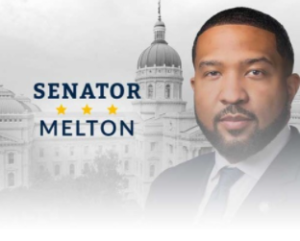
Melton Photo

MELTON COMMENTS ON ATTORNEY GENERAL ROKITA’S CRITICAL RACE THEORY REMARKS

“I was extremely disturbed after reading Attorney General Rokita’s remarks on Critical Race Theory (CRT) in his ‘Parents Bill of Rights.’” Senator Melton said. “History classes in the United States have long excluded certain parts of United States history that are hard to face. We can only move forward as a unified nation, with actual justice for all, if citizens are taught all of our history.

“CRT is a concept that has been around for over 40 years and is only now making the news because politicians have started using it to push a national agenda to block progress on inclusion and diversity. Parts of this theory have been in history curriculum for decades, and it simply teaches students that prejudice didn’t end with slavery but at times has also been built into legal systems and policies.

“For example, government officials have historically drawn lines around predominantly minority neighborhoods, known as redlining, and deemed them ‘poor financial risk.’ This resulted in banks refusing mortgages to Black families, denying them the opportunity to be homeowners and resulting in Black families building financial equity at a devastatingly disproportionate rate compared to white families.” Melton explained.

“We can only fix these sorts of policies if our future policymakers and attorneys learn about them in school. This nation cannot hide from its history of racism, and we cannot move past the racism that continues to permeate our country until we acknowledge and address its systemic roots.

“That understanding is partially why I was so disturbed when reading the disparaging comments about CRT in the ‘Parents Bill of Rights,’ because it suggests an aversion to acknowledging that truth and working to move past our country’s historic racism.

“I encourage Attorney General Rokita, as a leader of our diverse Hoosier state, to reexamine his statements on CRT and revise his ‘Parents Bill of Rights’ to retract the discriminatory and false claims that were made. I also want to encourage him to meet with me and the other members of the Indiana Black Legislative Caucus to discuss this issue further and to get a more accurate and comprehensive understanding of CRT.”

Statement from Indiana Senate Democrats website.
https://www.indianasenatedemocrats.org/melton-comments-on-attorney-general-rokitas-critical-race-theory-remarks/

NATIONAL URBAN LEAGUE

Nul Logo

NATIONAL URBAN LEAGUE PRESIDENT: FAILURE TO ADVANCE FOR THE PEOPLE ACT IS “A VOTE AGAINST DEMOCRACY”
Calls Filibuster “An Odious Remnant of Institutionalized White Supremacy”

FOR IMMEDIATE RELEASE

NEW YORK (June 22, 2021) — National Urban League President and CEO Marc H. Morial issued the following statement in response to tonight’s procedural vote on critical voting rights legislation:

“Members of the Senate tonight adhered to a deplorable, century-long tradition of using the filibuster to block civil rights legislation and thwart the will of the American people.

“The right to vote – a sacred right for which Americans have bled and died – is under attack in our nation’s state legislatures with a ferocity not seen since the dark days of Jim Crow.  Every Senator who voted against advancing the For The People Act tonight has cast a vote against democracy.

“The For the People Act would dismantle the racially-motivated barriers state legislatures are erecting around the ballot box, and limit the influence of a tiny minority of ultra-wealthy political donors.  Americans overwhelmingly support provisions of the Act.

“Senator Schumer is to be commended for his efforts to bring the bill to the floor, and we encourage him – and the entire Urban League movement – to continue fighting for passage of a robust For the People Act.

“Any final bill must:

• Remove voter ID mandates

• Promote internet, automatic, and same-day voter registration

• Restrict voter roll purges

• Penalize the spread of false election information and other voter intimidation practices

• Require at least 7 days notification for polling place changes

• Require at least 15 days of early voting for federal elections and early voting be near public transportation

“Tonight’s display of anti-democratic partisanship is further proof that the filibuster, an odious remnant of institutionalized white supremacy, must be eliminated.  We call on every Senator to heed what Lincoln called “the better angels of our nature,” and relinquish it to history.”

###

CONTACT:  Teresa Candori, National Urban League tcandori@nul.org

NATIONAL URBAN LEAGUE HONORS GEORGE FLOYD WITH 9 MINUTES AND 29 SECONDS OF ACTIVISM

Nul Logo

NATIONAL URBAN LEAGUE HONORS GEORGE FLOYD WITH 9 MINUTES & 29 SECONDS OF ACTIVISM
Anniversary of Floyd’s Murder To Be Marked With Debut of New Instagram Series, #JusticeNow

FOR IMMEDIATE RELEASE

NEW YORK (May 21, 2021) – The National Urban League and its network of 91 affiliates around the nation are mobilizing Americans to honor the May 25 anniversary of George Floyd’s murder by spending nine minutes and 29 seconds – the duration of the deadly assault – to demand robust federal police reform legislation.

“The murder conviction of George Floyd’s killer offered the nation a glimmer of hope that we have reached a turning point in the movement to end racially-motivated police violence,” National Urban League President and CEO Marc H. Morial said. “The deaths of Daunte Wright, Ma’Khia Bryant, Andrew Brown, Jr., at the hands of police revealed how much work remains to make that hope a reality.”

The nine minutes, 29 seconds of activism begins at 3 pm Eastern Time. Supporters are urged to flood social media with messages in support of the George Floyd Justice in Policing Act, to send a message to their senators by texting JUSTICENOW to 52886 or call the Senate switchboard at 202-224-3121.  Suggested hashtags for the mobilization are #RememberingGeorge and #JusticeForGeorge.

The National Urban League also will mark the anniversary with the debut of a new bimonthly Instagram Live series, #JusticeNow, centering social justice topics that deeply shape the lives of Black and brown communities.  The series premieres at 6 pm Eastern Time on Tuesday.

The approximate moment of his death, 9:25 pm Central Time will be observed with nine minutes and 29 seconds of silence and reflection.

“A year ago, Americans rose up in protest after watching George Floyd’s life crushed away by a knee on his neck,” Morial said. “Today we ask Americans to channel that protest into power and demand the Senate at last take action to create lasting change.”

###

Read  more CIVIL RIGHTS LEADERS CALL ON CONGRESS TO PASS GEORGE FLOYD JUSTICE IN POLICING ACT

CONTACT:  Teresa Candori, National Urban League tcandori@nul.org

NATIONAL URBAN LEAGUE UNVEILS “21 PILLARS,” A COMPREHENSIVE FRAMEWORK FOR REDEFINING PUBLIC SAFETY

Nul Logo

NATIONAL URBAN LEAGUE UNVEILS “21 PILLARS,” A COMPREHENSIVE FRAMEWORK FOR REDEFINING PUBLIC SAFETY

NEW YORK (April 26, 2021) — The National Urban League today released a comprehensive framework for criminal justice advocacy that takes a holistic approach to public safety, the restoration of trust between communities and law enforcement, and a path forward for meaningful change.

21 Pillars for Redefining Public Safety and Restoring Community Trust centers on five key themes that are fundamental to the protection and preservation of life, dignity, and trust, while also building safer communities.

“For too long the lives, safety, and freedom of communities around the nation, particularly Black communities, have been threatened by discriminatory and violent policing,” National Urban League President and CEO Marc H. Morial said. “Our communities deserve to feel safe in their homes, in their cars, and on their streets, including safe from police violence. The 21 Pillars is a vision of what is possible – a path forward. Public safety must be redefined.”

Each of the 21 Pillars addresses one of five goals for transforming public safety and includes several recommendations for achieving them on the national, state, and local levels:

  • Collaborate with communities to build a restorative system
    • Empower communities to re-envision public safety in an equitable and just way
    • End broken windows policing and implement community policing models
    • Prohibit profiling based on race, ethnicity, religion, sexual orientation, gender identity, disability, or immigration status
    • Address the needs of individuals experiencing mental health crises
  • Accountability
    • Hold police accountable in court
    • Prevent police union contracts from blocking accountability
    • Investigate police misconduct
    • Create or strengthen independent all-civilian community-based review boards with final authority
  • Change divisive policing policies
    • Revise use of force policies
    • Ban chokeholds, no-knock warrants, and shooting at moving vehicles
    • Eliminate police from schools
    • Demilitarize the police force
    • Ban civil asset forfeiture
  • Require transparency, reporting, and data collection
    • Collect data on police misconduct and use-of-force
    • Mandate use of dashboard and body-worn cameras and provide access to footage
    • Conduct financial and operational audits of police departments
    • Require transparency and community input with predictive policing facial recognition and any new technologies
  • Improve hiring standards and training
    • Adopt a national police accreditation system
    • Expand the National Decertification Index
    • Strengthen police hiring standards and improve training to build integrity and trust
    • Increase diversity and equity in both the leadership and ranks of local, state, and federal law enforcement

“The effects of unjust policing often reverberate beyond the criminal justice system, undermining social progress,” Morial said. “ Social parity, economic empowerment, and civil rights cannot be achieved in a world of unjust policing. Our 21 Pillars represent solutions that will move us closer to a world where community safety is real, and not aspirational.”

Read more about the 21 Pillars here: https://nul.org/index.php/program/police-reform

CONTACT:  Teresa Candori, National Urban League tcandori@nul.org

NATIONAL URBAN LEAGUE: DEREK CHAUVIN’S CONVICTION ON ALL COUNTS MARKS A TURNING POINT ON POLICE ACCOUNTABILITY

Nul Logo

NATIONAL URBAN LEAGUE: DEREK CHAUVIN’S CONVICTION ON ALL COUNTS MARKS A TURNING POINT ON POLICE ACCOUNTABILITY

MINNEAPOLIS (April 20, 2021) – The leaders of the nation’s top civil rights organizations issued the following statement in response to Derek Chauvin’s conviction on second-degree murder, third-degree murder, and second-degree manslaughter:

“Just as the viral video of George Floyd’s brutal death marked a turning point in the nation’s tolerance for racially-motivated police violence,  we are hopeful that today’s verdict marks a turning point in holding police accountable.

“With this verdict, the jury has made an unambiguous declaration that unwarranted use of force against Black people by police is a crime and that Black Lives Matter.

“Criminal prosecutions of police officers for misconduct, even fatal misconduct,  are extremely rare, and convictions are rarer still.  A major reason why is the so-called blue wall of silence, which suffered a major blow in this case when Chauvin’s former fellow officers took the stand against him. While truthful testimony is the very least we should expect from law-enforcement officers, we are nonetheless encouraged by the role their actions played in securing this conviction.“We commend the prosecution team assembled by Minnesota Attorney General Keith Ellison, who pursued justice with rigor and integrity.

“We must build on the movement their actions and this conviction represent by enacting the George Floyd Justice in Policing Act and putting an end to this pattern and practice of abuse.

“We profoundly appreciate that a measure of justice has been served by the jury’s decision, but today is not a day to celebrate. Rather, it is a time for somber remembrance of  George Floyd and all the lives lost to unjustified police violence. It is a time to rededicate ourselves to building a community of trust that keeps all Americans safe.”

###

Read  more CIVIL RIGHTS LEADERS CALL ON CONGRESS TO PASS GEORGE FLOYD JUSTICE IN POLICING ACT

CONTACT:  Teresa Candori, National Urban League tcandori@nul.org

National Urban League – Need for Police Reform: Assault of Lt. Nazario and Needless Death of Duante Wright

Nul Logo

NATIONAL URBAN LEAGUE HAILS HOUSE PASSAGE OF GEORGE FLOYD JUSTICE IN POLICING ACT; DEMANDS IMMEDIATE SENATE ACTION

NEW YORK (April 13, 2021) – National Urban League President and CEO Marc H. Morial issued the following statement in response to the killing of Daunte Wright and the assault of Army Lt. Caron Nazario by police in Minnesota and Virginia:

“Over the last few days the nation once again watched a young Black man, pulled over by police in what appears to be a pretextual stop, shot to death by officers incapable of or unwilling to de-escalate the encounter.

We watched officers cruelly taunt and needlessly assault a Black Army Medical Corps lieutenant with pepper-spray after another apparently pretextual traffic stop.

Our hearts are with the family of Daunte Wright, taken at just 20 years old, by an officer so poorly-trained and so eager to use excessive force that she allegedly mistook a gun for a taser.

“Our sympathy and support goes out to Lt. Caron Nazario who was pelted with death threats and conflicting demands before his unwarranted and unprovoked assault.”

“These tragic incidents have occurred or come to light even as the trial of Derek Chauvin has swept aside the illusion of justification for the use of force in cases like these. Witness after witness has testified that George Floyd posed no threat to the officers, and that Derek Chauvin continued using deadly force long after even the possibility of a threat had passed. Video of Daunte Wright’s fatal shooting and Lt. Nazario’s vicious assault make it clear that neither of them posed a threat to the officers who attacked them.

“Also swept aside is any excuse for the Senate’s delay in passing the George Floyd Justice in Policing Act. Each day that goes by without accountability for police misconduct is a black mark against a nation shamefully willing to tolerate the unjustified killing and assault of Black and Brown men and women.”

###

Read  more CIVIL RIGHTS LEADERS CALL ON CONGRESS TO PASS GEORGE FLOYD JUSTICE IN POLICING ACT

CONTACT:  Teresa Candori, National Urban League tcandori@nul.org

SB 368 – Juvenile Justice passed 87-0!

Childrens Policy And Law Initiative Of Indiana Image 4.5.21

Friday, April 9, 2021

Dear All,

SB 368 Juvenile Justice passed out of the Indiana House of Representatives with an 87-0 vote today!  Rep. McNamara, co-sponsor of the bill, advocated for the bill on the House floor, calling the bill “historic.”  Be sure to check out the attached Indiana Lawyer article that just came out this week. The good news is, this bill is well on its way to becoming Indiana law!

SB 368 addresses three critical issues for advancing youth justice in Indiana:

  1. Removal of  children  from adult jails while awaiting trial in the adult system;
  2. Juvenile Competency to Stand Trial, so children with mental illness, disabilities or just too young, do not enter the juvenile justice system in order to access services; and
  3. Automatic Expungement of juvenile misdemeanor records so that collateral consequences do not follow youth, placing barriers to education, employment, joining the military, housing and other essential aspects of life. 

SB 368 is authored by Sens. Karen Tallian (D), Jean Breaux (D), Sue Glick (R) and Jim Buck (R)—and includes important policies designed to treat children in an age- and developmentally-appropriate manner, confront systemic racism, disrupt the school-to-prison pipeline, and protect children in the justice system from dangerous and overly punitive practices.  Rep. Wendy McNamara (R), along with Reps. Greg Steuerwald (R), Matt Pierce (D) and Ragen Hatcher (D) co-sponsored the bill in the House. Please call or send emails thanking them all, and your own legislators today! You can find the name and contact information for your legislator by visiting http://iga.in.gov/legislative/find-legislators/ or calling (317) 232-9600.

Over 55 organizations and coalitions supported this bill, and countless individuals testified, wrote letters, made calls and sent emails to make this happen.

We thank you all!  Your efforts have and are making a critical difference for Indiana children.

Children’s Policy and Law Initiative of Indiana (CPLI)