Indianapolis Urban League

Civil Rights Activists and Congressman John Lewis: The IUL Joins the Nation in Mourning

Civil Rights Activists and Congressman John Lewis: The IUL Joins the Nation in Mourning

Iul Logo Nul

FOR IMMEDIATE RELEASE
July 18, 2020

The Indianapolis Urban League Joins the Nation in Mourning
the Passing of Congressman John Lewis

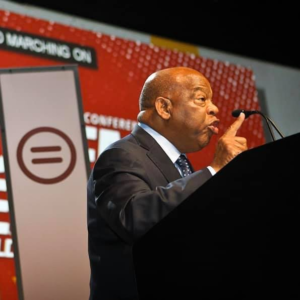
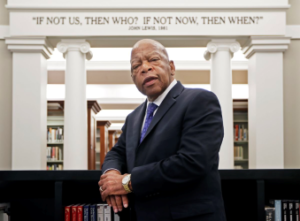
Indianapolis, IN (July 18, 2020) – Today, we join the nation in mourning the passing of Congressman John Lewis.

As Lewis remarked, his protest efforts were “…getting into good trouble”.  As one of the “Big 6” leaders of the Civil Rights Movement, Mr. Lewis stood tall leading and teaching generations how to be activist, from boycotts, to sit-ins, to protests, to boldly championing policy changes in Congress lifting and lending his voice fighting racism and injustice unselfishly until to the end.

Thank you for your courage, your endurance during a lifetime of sacrifice and commitment to change.

“Today the Indianapolis Urban League stands in solidarity with the nation in saluting your life of unwavering service to each of us as people of color and memorializes your passing to the arms of the God you faithfully served,” stated Tony Mason, President and CEO of the Indianapolis Urban League.

We have watched. We have learned. We will continue the legacy.  Rest in power!
##

Contact: Anthony “Tony” Mason, President & CEO
(317) 693-7603 and (317) 319-3141

_____________________________________________________

About the Indianapolis Urban League:
Founded in 1965, the Indianapolis Urban League (IUL) is a nonprofit, non-partisan, interracial, community-based, human services agency dedicated to assisting African-Americans, other minorities and disadvantaged individuals to achieve social and economic equality. Annually, the IUL provides direct services and advocacy in the areas of: education and youth services, economic and workforce development, health and quality of life, civic engagement and leadership, and civil rights and racial justice empowerment. IUL is one of 90 affiliates of the National Urban League serving 300 communities in 36 states and the District of Columbia. For more information visit indplsul.org


John Lewis 2
John Lewis 1

Need Help Paying Rent? New Program Open

20200708 Rental Assistance Program Flyer P1 7.9.20 Page 1

Click link to apply www.indyrent.org

20200708 Rental Assistance Program Flyer P1 7.9.20 Page 2
Mayors' Logo

Mayor Joe Hogsett, Unveils Details of

Rental Assistance Program

Program aims to assist those hit hardest by pandemic

INDIANAPOLIS (July 8, 2020) – This morning Mayor Joe Hogsett joined City-County Council President Vop Osili, Indianapolis Urban League President & CEO Tony Mason, Indianapolis Public Library CEO Jackie Nytes, and John Boner Neighborhood Centers CEO James Taylor to announce the details of the city’s rental assistance program.
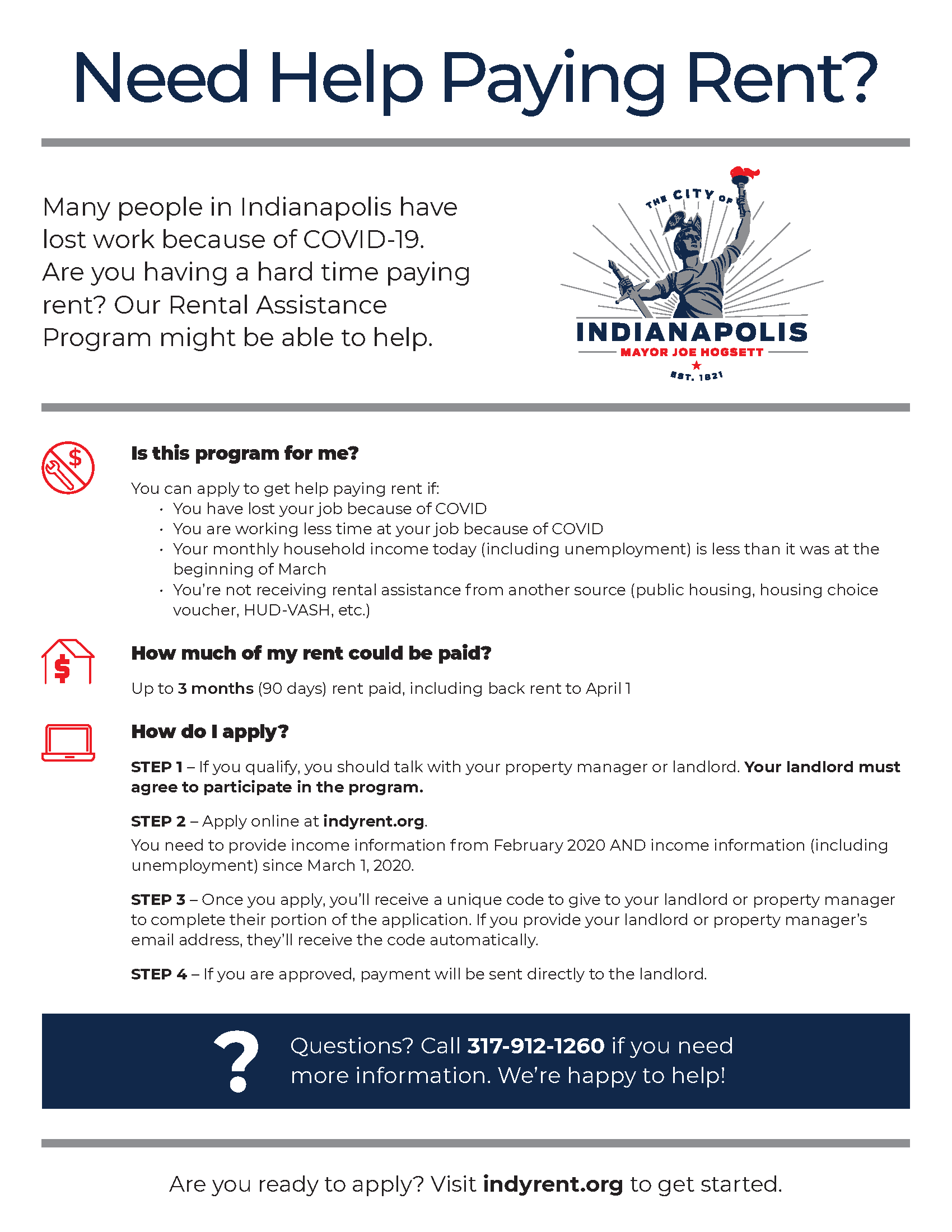
The program will provide up to three months of rent, including back rent to April 1, to residents struggling to pay rent due to the COVID-19 pandemic. It will begin on Monday, July 13.

“To whatever degree our way of life has endured, it is largely thanks to the oftentimes low-paid labor of men and women in our city,” said Mayor Hogsett. “This rental assistance fund can help more residents stay afloat in an uncertain time. If the need for assistance proves greater than this initial estimate, then we intend to go back to the Council to request an additional appropriation. As long as this pandemic affects the lives of Indianapolis families, the City of Indianapolis will be doing all we can to relieve and repair the hurt.”

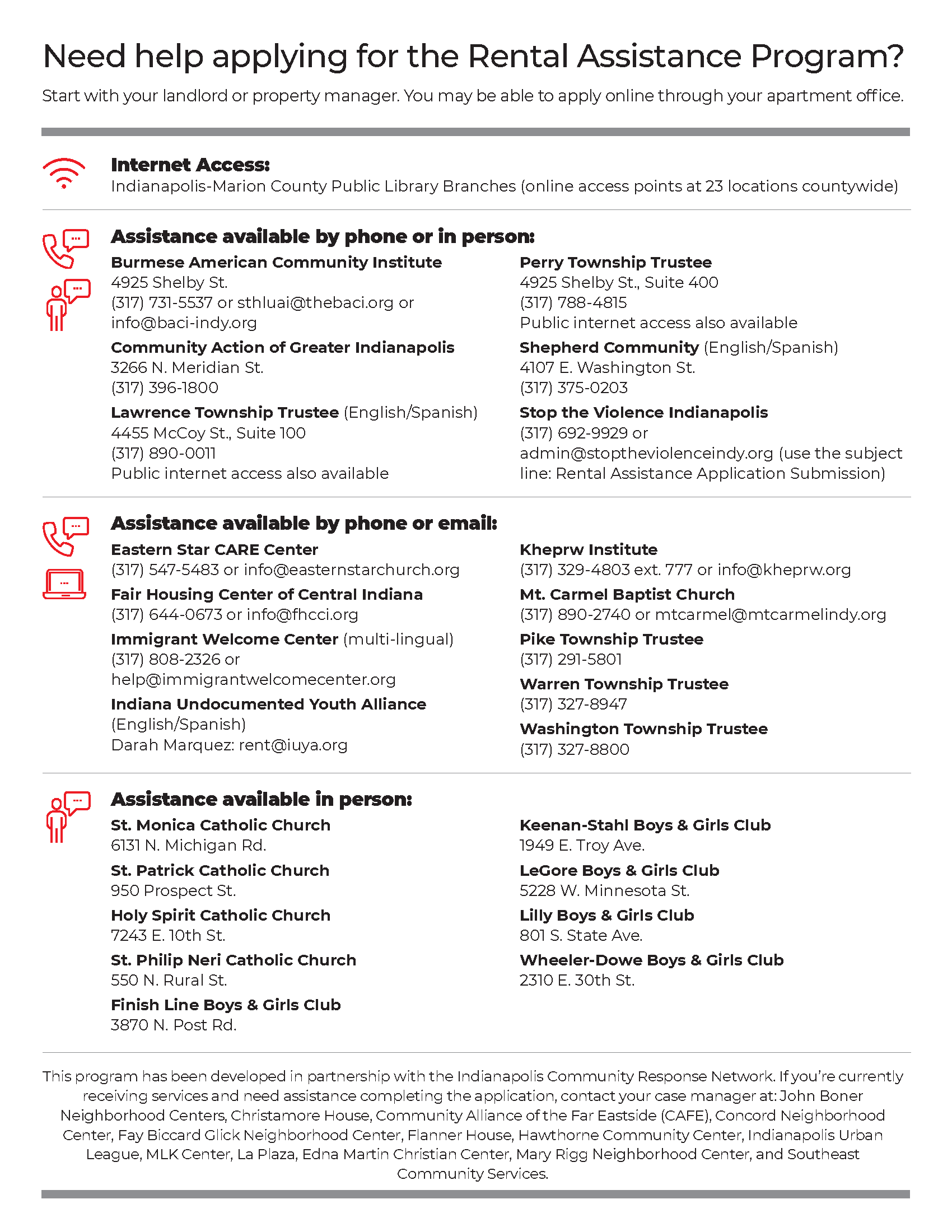
Residents may apply by going to indyrent.org. Renters will need to provide income information from February 2020 and income/unemployment information since March 1, 2020. Landlords must agree to participate in order for renters to receive assistance. Several community organizations will be available to assist residents with language and technology barriers. The attached flyer contains a list of community organizations and information on how to apply.

“We stand ready to support this work at a crucial time for our city,” said Urban League President & CEO Tony Mason. “Our network of community organizations will go far in ensuring that anyone eligible for this funding is aware and able to apply.”
The program is funded by $15 million of the nearly $80 million CARES Act funding approved by the City-County Council on June 8. At that time, it was announced that Lilly Endowment Inc. would commit additional philanthropic support to the program.

“Rental assistance can make an enormous difference for those whose lives have been upended by COVID-19,” said John Boner Neighborhood Centers CEO James Taylor. “Through extensive community partnerships, the benefits of the program will ripple across Indianapolis.”

Marion County residents can request a free face covering at indy.gov/masks. Indianapolis residents impacted by COVID-19 should visit the City of Indianapolis resource guide, which can be viewed at www.indy.gov/covid. Spanish speaking residents can view the Resource Guide here. Individuals who are unable to navigate the city’s website can call 317-327-4MAC between the hours of 8:00 a.m. and 5:00 p.m. to talk to a customer service representative.

                                                                         ###

36% APR Cap More Essential Now Than Ever – Protect Hoosiers from Predatory Lending

Indiana Institute For Working Families Logo

Consumer Financial Protection Bureau Declines to Protect Hoosier Families from Predatory Lending

36% APR Cap More Essential Now Than Ever

Indianapolis, IN July 7, 2020 – Today, the Consumer Financial Protection Bureau (CFPB) gutted a proposed protection against predatory lending, leaving Hoosier families exposed to the harms of payday lending. The 2017 Payday Rule, which was finalized but did not take effect, would have required that lenders verify a borrower’s ability to repay a loan before issuing it. Today, the CFPB issued a final rule without ability-to-repay requirements.

“Struggling Hoosier families need real assistance – not loans they cannot afford at unconscionable interest rates,” said Jessica Fraser, Director of Indiana Institute for Working Families. “Today’s move by the Consumer Financial Protection Bureau to gut the payday rule by stripping the ability-to-repay requirement will not only be devastating for families, it will ultimately hurt us all.”

Organizations and individuals throughout the state of Indiana have called on state and federal lawmakers to pass an interest rate cap of 36% or lower on small dollar loans, which has effectively protected residents of sixteen other states and military service members from the payday debt trap.

In 2002, the Indiana General Assembly granted payday lenders an exemption to Indiana’s loansharking law, which makes it a felony to issue loans at or above 72% APR. Under current Indiana law, payday lenders can loan out up to 20% of a borrower’s income up to a cap of $605 and these loans can reach up to 391% APR.

Payday lenders in Indiana have drained over $300 million in fees from Hoosier communities over the past five years. The median borrower income is estimated to be just over $19,000 per year.

“Racism and lack of opportunity must end in Indianapolis”, states Chair of GIPC

Iul Logo Nul

Keeping You Informed

Greater Indianapolis Progress Committee Logo For Press Release 6.18.20

GIPC  creates Race and the Legal Process Working Group

FOR IMMEDIATE RELEASE: June 18, 2020

INDIANAPOLIS – The Greater Indianapolis Progress Committee (GIPC) announced today the creation of the Race and the Legal Process Working Group, whose work will combat racism and bias in Indianapolis, as well as the disparate impact of pandemic-related events on the Black and other traditionally underrepresented minority communities. The Working Group will research and make recommendations on changing policing and police governance; and will create a pro bono “surge” team of lawyers to address the urgent needs of Black and other disadvantaged residents arising out of COVID-related economic hardship.
GIPC is composed of private sector corporate and community leaders and has engaged for over 50 years to improve Indianapolis. GIPC’s initiatives have included brick-and mortar projects such as the Sidney and Lois Eskenazi Hospital; as well as collaborative projects such as the Race and Cultural Relations Leadership Network, established by GIPC in 1994.

The actions announced today arise out of GIPC’s deep concern about the unjust impact of policing practices and policies on Black residents of Indianapolis, and the economic hardship experienced by disadvantaged Black and other traditionally underrepresented minority communities because of COVID-19.
Chaired by incoming Dean Karen E. Bravo of the Indiana University Robert H. McKinney School of Law, the Working Group is composed of two teams:

  • The Structural Reform Team, co-chaired by John Gaidoo, Assistant General Counsel, Cummins, Inc., and Joseph Smith, Partner, Faegre Drinker Biddle and Reath, will collaborate to provide research, policy recommendations and education on best practices, primarily in policing focused on the treatment of Black residents in Indianapolis equitably and with dignity.
  • The Pro Bono Legal Services Team, chaired by Myra Selby, former Indiana Supreme Court Justice and Ice Miller Partner, will create urgent surge capacity for pro bono legal services providers from the private sector legal community. This team will focus on such issues as the flood of housing evictions expected to occur when the state’s temporary moratorium on such actions is lifted.

Both teams intend to conclude work before the end of 2020 to facilitate near-term changes that lead to systemic change. “Racism and lack of opportunity must end in Indianapolis”, said Mary Titsworth Chandler, Chair of GIPC and Vice President of Corporate Responsibility and Community Relations for Cummins, Inc. “Our city simply will not advance unless Black residents are treated fairly, with dignity and access to opportunity.”

“I am honored to have the opportunity to lead this important effort,” said incoming Dean Bravo. “We can each play a role in combatting both bias and systemic racism. This Working Group is a tangible way for me to help to make a difference in our community.”

Contact:
Beth White GIPC Executive Director (317) 626-7851 Beth.White@indygipc.org

strong>About GIPC
Founded in 1965, the Greater Indianapolis Progress Committee (GIPC) is a private, nonprofit, and non-partisan organization that provides a forum in which leaders of the public and private sectors of Indianapolis can work as partners to study, discuss, and address issues of concern and areas of opportunity which affect the progress of the city. Driven by business and civic leaders, GIPC represents the bipartisan alliance that is a continuing example of public-private partnership in Indianapolis.

Leadership of the Urban League Movement Speaks with Unified Voice

Iul Logo Nul
Nul Logo

STATEMENT FROM

THE LEADERSHIP OF

THE URBAN LEAGUE MOVEMENT

Wednesday, June 3,2020

Indianapolis Urban League President and CEO Tony Mason, National Urban League President Marc H. Morial, along with Urban League affiliate leaders from around the country, speak with one voice in response to the civil unrest sweeping our community and the nation in the following statement:

Our communities are overwhelmed with grief. We are heartsick over the inhumanity we have witnessed in the recent deaths of Breonna Taylor, George Floyd and Ahmaud Arbery. We are appalled by the callous response from the authorities who shrugged in the face of evil.

Cities across the nation have erupted in rage and despair. As civil rights leaders who are committed to racial justice, we share the protesters’ anguish, and the heartbreak of the communities where uprisings have turned violent.

There are those who are inciting violence and mayhem. And there are those engaged in peaceful protest. No one should assume they are the same people, and we refute any attempt to discredit or dismiss the just cause for which people are marching based on infiltrators bent on sabotage. We support the right of citizens to engage in peaceful protest. We condemn the use of excessive force to dispel demonstrations.

We are hearing what Martin Luther King, Jr., famously called “the language of the unheard.” When George Floyd begged for his life as Minneapolis Police Officer Derek Chauvin pressed his knee into Floyd’s throat, he was unheard. The onlookers pleading with Chauvin to stop were unheard.

The cries for justice have gone unheard long enough.

The long-overdue arrests of Ahmaud Arbery’s killers and one of the officers involved in George Floyd’s death are merely a first step in a long journey. The other officers involved in Floyd’s killing also must be held accountable.

The Urban League Movement has proposed specific recommendations for police reform and accountability. These include the widespread use of body cameras and dashboard cameras, revision of use-of-force policies, officer training and hiring standards, and the immediate appointment of independent prosecutors to investigate police misconduct.

But even more than these measures, we need a revision of our culture. It’s a culture that teaches a white woman walking her dog in Central Park that racially-motivated police brutality is a weapon she can use to enforce her own preferred social code.

As we pursue these measures to reform the police in our communities, we call upon all community leaders, elected officials, corporate leaders and social institutions to join us in pursuing policies that promote racial reconciliation.

The Urban League Movement is comprised of the National Urban League and its 90 affiliates, serving 300 communities in 36 states and the District of Columbia.

  • Marc H. Morial, National Urban League
  • Tracee Adams, Urban League of Kansas, Inc.
  • Donna Lowe Alexander, Urban League of Union County, Inc.
  • N. Charles Anderson, Urban League of Detroit & Southeast Michigan
  • Ruben Anthony, Urban league of Greater Madison
  • William Barnes, Birmingham Urban League
  • Germaine Smith-Baugh, Urban League of Broward County
  • Tonja Sesley-Baymon, Memphis Urban League
  • Reverend Vincent Bell, Urban League of Greater Columbus, Inc.
  • Steve Belton, Urban League of the Twin Cities
  • Gilbert Bland, Urban League of Hampton Roads, Inc.
  • Laraine Bryson, Tri-County Urban League
  • Beneta Burt, Mississippi Urban League
  • Esther Bush, Urban League of Greater Pittsburgh
  • Thomas Conley, Greater-Warren Youngstown Urban League
  • Andrea Custis, Urban League of Philadelphia
  • Richard Danford, Jacksonville Urban League
  • Mable Davis, Morris County Urban League
  • George Dean, Greater Phoenix Urban League
  • Dr. Quinton Dixie, Fort Wayne Urban League
  • Sean Dogan, Urban League of the Upstate, Inc.
  • Anthony Dubose, Urban League for Bergen County
  • Quincy Dunlap, Austin Area Urban League
  • Warren Evans, Jr., Las Vegas Urban League
  • Nancy Flake Johnson, Urban League of Greater Atlanta
  • Patrick Franklin, Urban League of Palm Beach County, Inc.
  • Vivian Cox-Fraser, Urban League of Essex County
  •  Molly Gilbert, Tucson Urban League
  • Theodia Gillespie, Quad County Urban League
  • Glenton Gilzean, Central Florida Urban League
  • Gwendolyn Grant, Urban League of Greater Kansas City
  • Dr. Eve M. Hall, Milwaukee Urban League
  • James Hall, Urban League of Racine & Kenosha, Inc.
  • Scott Hamilton, The Urban League of the State of Arkansas
  • Clifton Harris, Urban League of Middle Tennessee
  • Nina Harris, Springfield Urban League Inc.
  • Seanelle Hawkins, Urban League of Rochester, Inc.
  • Stephanie Hightower, Columbus Urban League
  • Watson Haynes, Pinellas County Urban League
  • David Hopkins, Urban League of Greater Hartford
  • Erin Houston, Shenango Valley Urban League
  • Cassandra Jennings, Greater Sacramento Urban League
  • Nkenge Harmon Johnson, Urban League of Portland
  • Joseph Jones, Grand Rapids Urban League
  • Ray King, Urban League of San Diego County
  • Eddie L. Koen, Urban League of Greater Southwestern Ohio
  • George H. Lambert Jr., Greater Washington Urban League
  • Michael Lawson, Los Angeles Urban League
  • Beverly Ledbetter, Urban League of Rhode Island Inc.
  • Teresa LeGrair, Akron Community Service Ctr & Urban League
  • Jennifer Lesko, Broome County Urban League
  • Warren E. Logan, Jr., Urban League of Greater Chattanooga
  • Brenda Walker McCain, Madison County Urban League
  • Vanessa Allen McCloud, Urban League of Northwest Indiana
  • William Teddy McDaniel, Urban League of Central Carolinas, Inc.
  • Brenda W. McDuffie, Buffalo Urban League
  • Diane McLaughlin, Northern Virginia Urban League
  • James T. McLawhorn, Columbia Urban League
  • Michael McMillan, Urban League of Metropolitan St. Louis
  • Tony Mason, Indianapolis Urban League
  • Tiffany Majors, Greater Baltimore Urban League
  •  Otha Meadows, Charleston Trident Urban League
  •  Michelle Merriweather, Urban League of Metropolitan Seattle
  • Marsha Mockabee, Urban League of Greater Cleveland
  • Judy Morse, Urban League of Louisiana
  • Dr. J. Keith Motley, Urban League of Eastern Massachusetts
  • Cynthia Mullins, ESQ, Urban League of Southern Connecticut
  • Phyllis Nichols, Knoxville Area Urban League
  • T’wina Nobles, Tacoma Urban League
  • P.G. Peeples, Urban League of Lexington-Fayette County
  • James Perry, Winston-Salem Urban League
  • Reverend Del Phillips, Urban League of Metropolitan Denver
  • Sadiqa Reynolds, Louisville Urban League
  • Arva Rice, New York Urban League
  • Judson Robinson, Houston Area Urban League
  • Diane Stevens Robinson, Greater Stark County Urban League
  • Theresa Sanders, Urban League of Long Island
  • Sorraya Sampson, Urban League of Westchester County
  • Parris Smith, Lorain County Urban League
  • Curtis Taylor, Tallahassee Urban League
  • Henry Thomas III, Urban League of Springfield
  • Valerie Thompson, Urban League of Greater Oklahoma City
  • Muhammad Umar, Urban League of Hudson County
  • Kyra Wallace, Southwestern Michigan Urban League
  • Thomas Warren, Urban League of Nebraska
  • Reverend George Wilkinson, Urban League of Flint
  • Karen Freeman-Wilson, Chicago Urban League
  • Eugene Young, Metropolitan Wilmington Urban League

Broad segments of our community believe Black lives matter.

Iul Logo Nul

African American Coalition Of Indianapolis Logo

AFRICAN AMERICAN COALITION OF INDIANAPOLIS – AACI

Indianapolis, IN, May 31, 2020 – The last several days a multiracial and multi-generational protest against the realities of being Black in America and in Indianapolis has convened in our city—and it was a powerful affirmation that broad segments of our community believe Black lives matter.

IMPD has recognized that organized efforts to protest have been peaceful. Unfortunately, a small group of agitators with motives and intentions to loot, riot and be violent are jeopardizing such efforts. We strongly condemn such actions.

We also refuse to allow such actions to delegitimize our community’s concerns. We cannot allow such actions to shift the narrative from Black men and women dying to the violence inflicted by agitators on our hometown.

Black people in Indianapolis face social and economic realities that are the result of institutional racism and/or policies implemented by democratically elected officials who were either willfully unconcerned about racial inequity or practiced a policy of indifference.

Even now we have to fight for basic rights and dignities that are already afforded to us by the US Constitution. Black Lives Matter.

We will continue to support peaceful protest. Our community is resilient, but we are tired. We have taken to heart that a multiracial and multi-generational coalition of Indianapolis residents see our frustrations, are willing to hear our concerns and have supported the call for progress.

African American Coalition of Indianapolis Steering Committee

About the African American Coalition Statement on Protests

The African American Coalition of Indianapolis (AACI) is a non-partisan collaboration of African-American civic, social, professional, service and community organizations with a goal to educate and engage African Americans in the local, state and national political process.

IUL Statement: Riots, the Language of the Unheard

Iul Logo Nul

FOR IMMEDIATE RELEASE                                                                      

May 31, 2020

Indianapolis Urban League Statement: Riots, the Language of the Unheard

Social justice is not a concept, it is a commitment

Indianapolis, IN (May 31, 2020) – Many are familiar with a famous observation by Martin Luther King, Jr., “…a riot is the language of the unheard.” What people seldom remember is his observation afterward that is just as salient and relevant today, “And what is it that America has failed to hear? It has failed to hear that the promises of freedom and justice have not been met. And it has failed to hear that large segments of white society are more concerned about tranquility and the status quo than about justice and humanity.”

This quote, from Dr. Kings’ 1967 “The Other America” speech given at Stanford University, crystallizes what lies at the heart of the frustrations that have been aired both verbally and physically this past weekend in Indianapolis and across our nation.

Inequality is a reality in Indianapolis. Inequality of employment, housing, education, health care, and justice go unheard from generation to generation. What we are experiencing in our city, and cities across our country, is the language of pain when people’s spirits are broken and they move beyond hopelessness to outrage.

We shutter at the display of violence and the visible outcome of the broken glass and desecration of monuments, sidewalks, and things deemed valuable by, and to, our community, yet for decades leaders have been willing to look past the visible scars of destruction and disparity of social injustice passed from generation to generation of people of color.

The scars of repeated history are the persistent victimization of Blacks from Eric Garner, to Sandra Bland, to Ahmed Aubrey, to Breonna Taylor, to George Floyd, and from Michael Taylor to Aaron Bailey to Dreasjon Reed; only the names change but the outcomes remain the same. Black men and Black women die at the hands of law enforcement and rarely are the officers charged, prosecuted, and convicted for their crimes even though we witness them in real-time.

Peaceful protests are a constitutional right and must be permitted to continue. However, those who are rioting, damaging property, and looting should be held accountable and so must our city hold officers of the law to the same level of accountability for its actions. Now that this happened in our city, it will continue to happen unless things change.

The trauma of history a third of our community experiences daily from Black unemployment rates than triple that of Whites, to a lack of affordable housing, to under-resourced and under-performing schools,

to persistent and growing health disparities, to a lack of investment in communities of color that breed and feed both the perception and reality of second-class citizenship for Blacks in Marion County.

If you are born poor in Indianapolis, you are likely to die poor in Indianapolis. Indianapolis ranks near the bottom in social mobility. Marion County has the fourth-highest rate of poverty in the state of Indiana at 19.8% but the poverty rate for Blacks is 28%. Since 2000, the homeownership rate for Black households in Marion County has sharply declined to less than 40%. Black neighborhoods are being gentrified and Blacks are being displaced.

Discussions around equity, economic inclusion, livable wages, affordable housing, school improvement, and police reform must move from talking to commitments accompanied by long-term financial investments from the city, the state, corporations, and philanthropies towards sustainable solutions.

Social justice is not just a concept, it is a commitment to creating a fair and equal society in which each individual matters, their rights are recognized and protected and decisions are made in ways that are fair and honest. Those we seek to help must be included in the process and their voices must be heard. These problems of inequality not only exist in Indianapolis but are pervasive throughout our state. They are not just problems for Blacks and Latinos living in urban communities, these are the same problems being experienced by poor Whites living in both urban and rural communities. The diversity of the protesters and the diversity of those who struggle to survive throughout our community and across our state should be notable to all.

While the COVID-19 virus prevents us from physically embracing at this time, it is more important than ever that we join together in understanding the impacts of the contagions of discrimination, racism, and inequality.

The leadership and citizenry of Indianapolis and the State of Indiana must re-commit themselves to being genuinely inclusive, broad-based, and pro-active so that the language of pain from the excluded and unheard gives way to equity, true justice, and humanity. This is our only choice and the only way forward to a better place and quality of life for all.

 Contact: Tony Mason,  President & CEO, Indianapolis Urban League

(317) 693-7603   tmason@indplsul.org


About the Indianapolis Urban League:
Founded in 1965, the Indianapolis Urban League (IUL) is a nonprofit, non-partisan, interracial, community-based, human services agency dedicated to assisting African-Americans, other minorities and disadvantaged individuals to achieve social and economic equality. Annually, the IUL provides direct services and advocacy in the areas of education and youth services, economic and workforce development, health and quality of life, civic engagement and leadership, and civil rights and racial justice empowerment. IUL is one of 90 affiliates of the National Urban League serving 300 communities in 36 states and the District of Columbia. For more information visit indplsul.org
Even in these trying times, some things should not happen. ACCI Statement on Threats to Police and Community

Iul Logo Nul

African American Coalition Of Indianapolis Logo

AFRICAN AMERICAN COALITION OF INDIANAPOLIS – AACI

Indianapolis, IN, May 22, 2020 –

Since the beginning of this year, our community has dealt with too many traumatic events.

We have experienced a surge in violence leading to over 40 African Americans murdered including 3 juveniles. We know that both 16-year old Nya Cope and 8-year old Rodgerick Payne Jr. were killed by stray bullets. IMPD officer Breann Leath was murdered while serving in the line of duty. More recently the police action shootings of Dreasjon Reed and Mchale Rose have strained police and community relations.

This has all occurred while facing the consequences of a public health crisis. But even in these trying times, there are things that should not happen.

Threatening law enforcement officers and their families is intolerable. As some suggest, doing so is not ‘protest language’.

Also, suggesting that youth should be taught to ambush police puts youth, our most precious gift, in grave danger. Our responsibility is to protect our youth; not to put them in harm’s way. We strongly condemn this behavior.

We must also emphasize that a law enforcement officer should never promote an “us” versus “them” mentality or offer veiled threats toward the community.  This sense of terror only adds to the historical trauma that our community has experienced and places a continuous strain on police and community relations. The thought that sworn police officers are not subject to the same justice system we all must use is both dangerous and unprofessional. Our community will never accept threats of violence from anyone representing a police organization including the FOP.

We continue to promote the language and value of accountability of the police department, elected and established leadership, and the community. We need to engage in vigorous debate, and even protest while maintaining respect for the ambitions of impacted families and monitoring the machinery of justice. We commit to do more than complain about systems, we must invest in training and organizing efforts that make the changes that align with our Black Agenda and Social Contract.

As our community continues to heal, it is incumbent on each of us to provide space for sharing frustrations, unresolved grief and anger. While doing so, we must also remain mindful of our collective responsibility to use language and actions that informs, empowers and helps rather than seeking to intimidate one another.

Indianapolis Urban League

Concerned Clergy of Indianapolis

Exchange at the Indianapolis Urban League

Indiana Black Expo

Purpose for My Pain

Young Men, Inc.

Indianapolis Recorder

National Coalition of 100 Black Women, Indianapolis Chapter

National Council of Negro Women, Indianapolis Section

100 Black Men of Indianapolis

The Black Men’s Group

Indianapolis Alumnae Chapter Delta Sigma Theta Sorority, Inc.

Iota Phi Theta Fraternity, Inc. Alpha Alpha Omega Indianapolis Alumni Chapter

Interdenominational Ministerial Alliance

About the African American Coalition

The African American Coalition of Indianapolis (AACI) is a non-partisan collaboration of African-American civic, social, professional, service and community organizations with a goal to educate and engage African Americans in the local, state and national political process.

IUL Statement – “Reprehensible” Facebook Meme of Black children dancing in underwear

Iul Logo Nul

FOR IMMEDIATE RELEASE                                                                      

May 15, 2020

Indianapolis Urban League Statement Concerning the “Reprehensible” Facebook Meme of State Representative Jim Lucas

Indianapolis, IN – Indianapolis Urban League President & CEO Tony Mason decried the Monday, May 11th Facebook meme posted by State Representative Jim Lucas (Seymour) as “reprehensible and utterly insensitive!”

Mason stressed, “given Blacks comprise only 9.1% of Indiana’s population, Lucas’ meme clearly promotes racist notions and stereotypes!” The meme portrays young Black children dancing in underwear and quotes them as saying, “We gon’ get free money!” This was State Representative Lucas’ response to the COVID-19 Relief Assistance sent to most American households in April.

“Mason further stressed, with over 640,000 Hoosiers dealing with unemployment, and many facing life and death challenges due to the COVID-19 pandemic, Lucas’ meme is especially ill-timed.  At a critical time for all residents of our state, a political leader such as State Representative Lucas should be using his position and platform to aid suffering Hoosiers; especially Hoosiers of Color, who have been disproportionately and fatally impacted by this health and economic crisis.  Blacks are suffering over 16% of COVID-19 deaths and Hoosiers in general are struggling to survive economically.  Now is not the time for partisan, racist memes that only serve the purpose of disparaging and dividing Hoosiers when so many of us are uniting, now more than ever, to aid struggling families.  Hopefully, Republican leaders who have been disturbingly silent will condemn Representative Lucas’ actions.”

The Indianapolis Urban League urges those rightly offended to express their strong dismay to House Speaker Todd Huston and other Republican political leaders, including Governor Holcomb.

###

 Contact: Tony Mason,  President & CEO, Indianapolis Urban League

(317) 693-7603   tmason@indplsul.org


About the Indianapolis Urban League:
Founded in 1965, the Indianapolis Urban League (IUL) is a nonprofit, non-partisan, interracial, community-based, human services agency dedicated to assisting African-Americans, other minorities and disadvantaged individuals to achieve social and economic equality. Annually, the IUL provides direct services and advocacy in the areas of: education and youth services, economic and workforce development, health and quality of life, civic engagement and leadership, and civil rights and racial justice empowerment. IUL is one of 90 affiliates of the National Urban League serving 300 communities in 36 states and the District of Columbia. For more information visit indplsul.org