Indianapolis Urban League

Indiana 211: Connecting Hoosiers to Holiday Support and Essential Resources

Indiana 211: Connecting Hoosiers to Holiday Support and Essential Resources

Indiana 211: Connecting Hoosiers to Holiday Support and Essential Resources

(December 16, 2025) – As the holiday season approaches, Indiana 211 is reminding Hoosiers that help is only three digits away. Whether families are seeking holiday meals, toy assistance, winter shelter, or support with basic needs, Indiana 211 is available?to connect residents with local, trustworthy resources across all 92 counties. 

Holiday and Winter Resource Support

  • Hoosiers can contact 2-1-1 or search online at in211.org for statewide assistance programs including:

 Holiday Meals & Food Programs

  • Christmas meal sites
  • Emergency food pantries
  • Holiday food box programs
  • Community meals with extended winter hours

Winter Shelter & Warmth Resources

  • Warming centers and overnight emergency shelters
  • Severe Weather Contingency shelters
  • Utility assistance agencies for heating support

Holiday Giving Programs

  • Toy distribution
  • Holiday clothing drives

Mental Health & Crisis Support

  • Immediate emotional support
  • Connections to local counseling, warm lines, and crisis teams
  • Referrals for grief support resources

If you or someone you know is currently experiencing thoughts of suicide, or a mental health or substance use crisis, please call 988 to reach Suicide & Crisis Lifeline and speak with a trained crisis specialist 24/7.

Get Help or Speak with a Community Navigator

Phone: Dial 2-1-1 or 1-866-211-9966 

Available Mon.- Fri., 8 a.m. to 6 p.m.

or

Text: Text your ZIP Code to 898-211

Available Mon.- Fri., 8 a.m. to 5 p.m.

AACI Leads More than 30 Civic Organizations in Opposition to HB1032

AACI Leads More than 30 Civic Organizations

in Opposition to HB1032

INDIANAPOLIS (December 10, 2025)—The African American Coalition of Indianapolis, AACI, a coalition of independent organizations, and coalition partners, unequivocally opposes the proposed mid-decade redistricting in Indiana. This proposed action is a blatant effort to manipulate political power at the expense of voters—including African American communities. It is nothing short of an assault on democratic principles of fairness and equal representation for all citizens.

HB 1032 is an unprecedented, highly partisan attack on the political efficacy of minority communities, such as Marion, Lake, Allen, Johnson, and St. Joseph counties. It has been suggested that over 2 million Hoosiers in urban, suburban and rural communities will be impacted by this bill.

Indiana law is clear: redistricting occurs after the decennial census to ensure fair and equal representation based on updated population data. There is no statutory or constitutional mandate for mid-decade redistricting. Any attempt to redraw maps now is not about fairness—it is about partisan advantage. It is a dangerous precedent that undermines the predictability and stability our electoral system depends on.

Historically, African Americans in Indiana have fought hard for representation—from overcoming Jim Crow-era voter suppression to challenging discriminatory practices in the courts. Mid-cycle redistricting, as proposed, threatens to roll back decades of progress to further engage Black voters in the political process and to gain further attention and accountability to address the unique needs and the commonly shared community concerns for all Hoosiers, such as quality education for all students and access to quality, affordable health care. We refuse to be silent while some seek to return Indiana to a time when political forces ruled Indiana that officially tried to silence Black voices and didn’t truly benefit all Hoosiers.

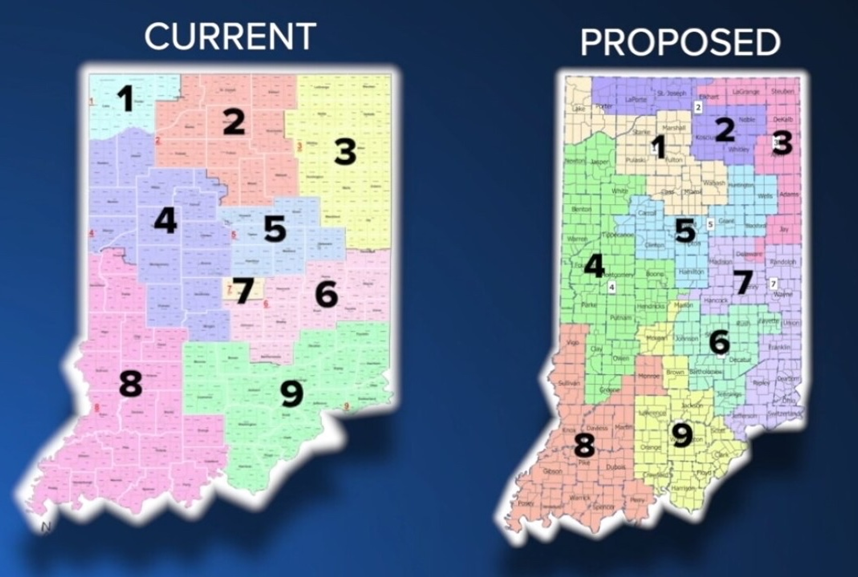
The proposed HB1032 maps would divide Marion County into four congressional districts. Under this plan, an Indianapolis resident near 38th & High School Road could be represented alongside voters living near the Ohio River, despite vastly different community needs. According to nonpartisan analysis, each district touching Marion County would drop to about 11% Black and 4% or less Hispanic population, weakening the ability of communities to elect representatives who understand local priorities. Current evidence is that many outsiders promoting Indiana redistricting aren’t making decisions and establishing priorities that are improving the quality of life for all Hoosiers,

Lawmakers attempt to rewrite the rules midstream is not governance—it is gerrymandering in its most cynical form. We call on every elected official to reject this power grab and uphold the principles enshrined in both Indiana law, in the Voting Rights Act, and in common sense decision making that promotes the best interest of all Hoosiers.

This process turns our democracy on its head with elected officials choosing their voters versus voters choosing who represents them. This is not what democracy looks like.

Our democracy is not a game. We are Hoosiers that want the best for us all.

Coalition Partners                            

Concerned Clergy of Indianapolis

Circle Up Indy

Evansville NAACP Branch #3048

Exchange at the Indianapolis Urban League

Fathers and Families Center

Flanner House

Fort Wayne Urban League

Greater Gary NAACP Branch #3050

Greater Indianapolis NAACP Branch #3053

Greater Terre Haute NAACP Branch #3068

Indiana Black Expo

Indiana Black Expo—Anderson Chapter

Indiana Black Expo—Elkhart Chapter

Indiana Black Expo—Gary Chapter

Indiana Black Expo—Indianapolis Chapter

Indiana Black Expo—Kokomo Chapter

Indiana Black Expo—South Bend Chapter

Indianapolis Professional Association

Indianapolis Urban League

Indy Black Chamber of Commerce

Interdenominational Ministerial Alliance of Indianapolis

What Hoosiers Need to Know about HB1032 and What Can Be Done Now

What Hoosiers Need to Know about HB1032 and
What Can Be Done Now

Overview 

Mid-decade redistricting, or redrawing political boundaries outside of the ten-year census cycle, is legally permitted in the United States but is relatively uncommon. When proposed, it raises important questions about representation, community cohesion, and public trust. Indiana has not historically engaged in mid-cycle redistricting, making current developments worthy of close public attention.

The Indiana House has introduced and passed HB1032 and released proposed congressional maps. Consideration of this legislation now shifts to the Indiana Senate, where public engagement will play a critical role.

Key Facts 

1. Legal Context

  • Mid-decade redistricting is constitutional but controversial.
  • Federal courts continue to review racial gerrymandering claims under the Voting Rights Act and the U.S. Constitution.
  • Courts have made clear that minority vote dilution, whether through packing or cracking, is unlawful.

2. Indiana at a Glance

  • Indiana has nine congressional districts.
  • Proposed maps would divide Marion County into four districts.
  • Modeling suggests minority populations would be redistributed in ways that reduce their ability to elect candidates of choice.
  • Counties including Marion, Lake, Allen, Johnson, Hamilton, and St. Joseph would be split in ways not clearly justified by population balance.

3. Considerations for Minority Representation

  • Section 2 of the Voting Rights Act prohibits minority vote dilution.
  • The Fourteenth Amendment limits the use of race as a predominant factor unless necessary to comply with federal law.
  • Analysis from nonpartisan groups indicates Black and Latino voters would be dispersed across several districts, weakening collective influence.
  • Attempts within HB1032 to restrict judicial review raise additional constitutional concerns.

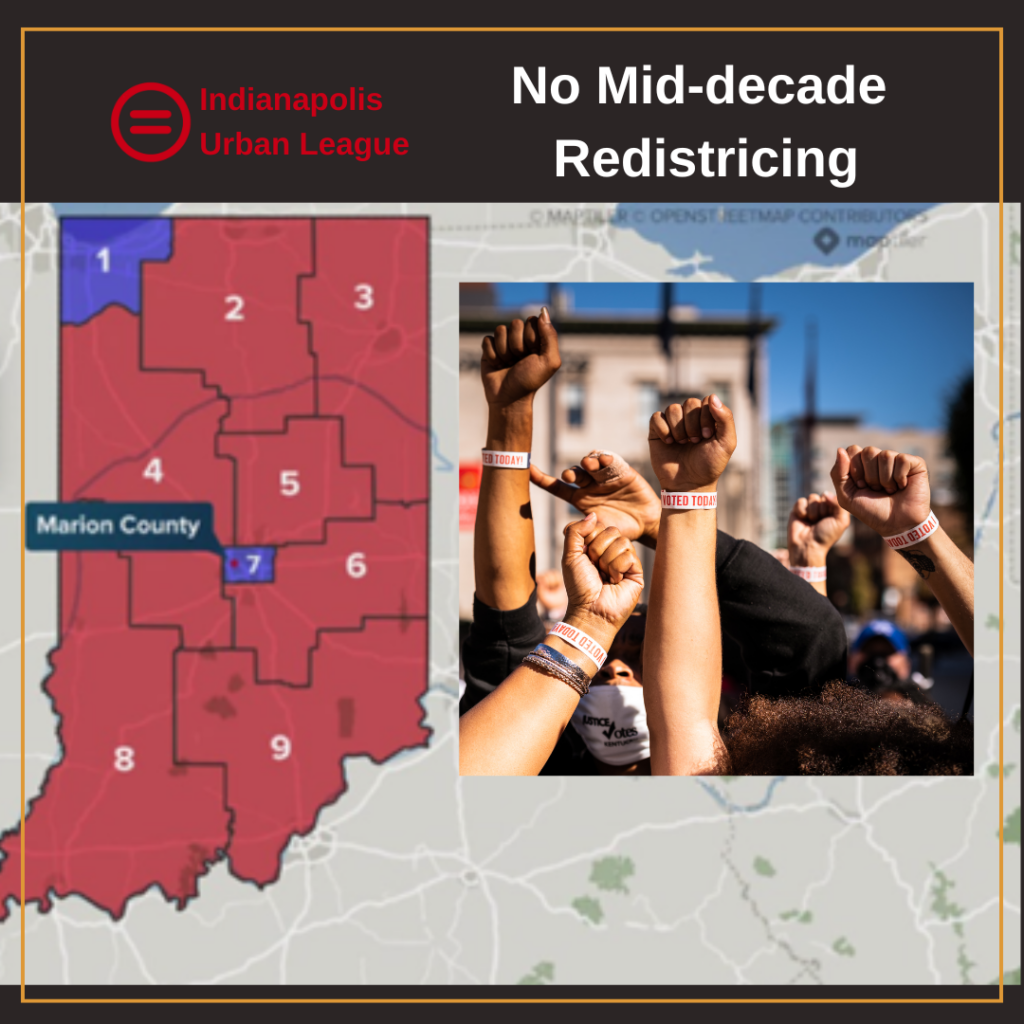
7th District Impact: Today, Indiana’s 7th Congressional District includes all of Marion County, the state’s most racially diverse county, where the population is approximately 49% white, 33% Black, and 12% Hispanic or Latino. Under HB1032, Marion County would be split across four districts, each reduced to about 11% Black and 4% or less Hispanic population, significantly weakening the ability of minority voters to collectively influence representation.

4. Policy Priorities for Hoosiers

  • At a time when families across Indiana are concerned about health care access, food affordability, utility costs, education, and workforce stability, many residents question whether mid-cycle redistricting reflects the most pressing needs of communities statewide.

Why the Senate Matters 

The Indiana Senate will determine whether HB1032 advances. Senators have the authority to vote the bill down or prevent it from moving forward. Previous Senate actions demonstrate that lawmakers can choose to prioritize stability and core policy issues over mid-cycle map changes.

Call to Action 

Hoosiers are encouraged to remain informed and engaged by doing the following:

  • Review the proposed HB1032 redistricting maps
  • Share feedback respectfully with Indiana Senate leadership
  • Contact Senate offices to express opposition to mid-cycle redistricting and HB1032
  • Emphasize the need to focus legislative efforts on issues affecting daily life, including health care, food access, utilities, and cost of living

Indiana Senate contact line: 

(317) 232-9400

Public participation helps ensure decision-making remains transparent, accountable, and responsive to community needs.


Daryl Mason, Butler basketball rebounds leaders from Broad Ripple who was a ‘team player’ died

Give a gift in memoriam.

The Indianapolis Urban League mourns the passing of the late Daryl Mason, a fraternity brother of the late Sam H. Jones (Omega Psi Phi).

Per the IndyStar

Mr. Daryl Lynn Mason, 73, transitioned to eternal life on November 17, 2025. On Wednesday, December 3, there will a Celebration of Life Service at 12:00 p.m. with visitation from 10:00 am and Omega Psi Phi Fraternity Memorial Service at 11:30 a.m. at University United Methodist Church, 5959 Grandview Drive, and interment at Crown Hill Cemetery. Services will be streamed via University United Methodist Church.  Memorial contributions may be made to: Indianapolis Urban League, 777 Indiana Avenue, Indianapolis, IN 46202, and Indianapolis Uplift Foundation Inc., (of which Omega Psi Phi is a sponsor) P.O. Box 441458, Indianapolis, IN 46244.

Daryl Mason, Butler basketball rebounds leader from Broad Ripple
who was ‘team player in life,’ died

Portrait of Akeem GlaspieAkeem GlaspieIndianapolis Star
  • Former Butler basketball star Daryl Mason died from lung cancer at the age of 73.
  • Mason holds multiple rebounding records at Butler, including for a single game, single season and career.
  • Off the court, Mason ran a consulting business for over 25 years, focusing on philanthropy and business development.
  • He was known for his dedication to his community and his role as a team player in both sports and life.

Growing up the son of longtime Indianapolis Public School educators Joseph and Evelyn Mason, giving back and helping his community was in former Broad Ripple and Butler basketball star Daryl Mason’s blood.

Off the court, Mason dedicated his life to helping others through his consulting business, Mason Consulting. For more than 25 years he worked with local businesses like the Lilly Endowment and the Indianapolis Urban League, consulting on philanthropy and business development.

Mason had a passion for helping others, the same way former Indiana Pacers players Darnell Hillman and Mel Daniels helped him develop his elite rebounding ability. Mason’s play style was molded by a saying from the former Pacers, “if you want to rebound, you’ve got to own it.” And that’s exactly what he did.

Mason, a member of Butler basketball’s 1970’s All-Decade team and considered one of Butler’s greatest rebounders, died Monday morning from lung cancer. He was 73 years old.

Mason played for Butler from 1971 to 1974. He holds Butler records for single-game rebounds (26), single-season rebounds (354) and career rebounds (961). His 354 rebounds during the 1972-73 season ranked 12th in the nation. He averaged a double-double in two out of three seasons.

“He determined early on that (rebounding) was going to be his contribution to the game and his team,” Mason’s former Butler teammate Clarence Crain said. “He prided himself on rebounding, so much so that he still holds the rebounding record at Butler which will probably never be broken in today’s era of NIL.

“He was a team player in sports and he was a team player in life. … All of those things worked toward helping people be the best they can be in a team setting. He was truly a team player.”

Butler center and program's all-time leading rebounder Daryl Mason.

As a sophomore in 1971, the 6-foot-7 center averaged 11.8 points and 11.1 rebounds a game. In 1972, Mason averaged 8.2 points and 13.6 rebounds per game. In his final season at Butler, Mason averaged 11.9 points, 12.2 rebounds and 2.0 assists per game. Five times, Mason recorded 19 or more rebounds in a game. For his career, Mason shot 42% from the field and 55% from the free throw line.

“The fact that you could get that many rebounds tells you that he had a nose for the ball,” Billy Shepherd, Mason’s former Butler teammate, said. “He just had a nose for the ball and was willing to go after it. He didn’t worry about a lot of the other things; he just wanted to rebound.

“I think a lot of times that says a lot about a player. You find something that you do well, and you go do it. Daryl was the ultimate guy at doing that.”

When Mason wasn’t working at his consulting business, he enjoyed traveling. Mason made several trips to Hawaii, Ghana and parts of Europe. The wiry center was a well-traveled man, but his heart was always with his hometown.

Rewind: Putting together the best Broad Ripple basketball team

Mason starred for Broad Ripple as a senior, averaging 16.8 points and 10 rebounds. Mason was considered by IndyStar as one of Broad Ripple’s all-time best players.

He loved being around his teammates, he loved being around Butler,” Shepherd said. “He had a nice high school career, and he built on that at Butler. … He had a great sense of going after the ball and had excellent timing. A lot of guys can jump high, but he was a quick jumper who could jump high.

“What I recall the most is his consistency. You just knew going out that he was going to be the guy to get you 15 to 20 rebounds. I wouldn’t say that’s a lost trait, but you don’t find that much anymore.”

Fair Housing Center of Central Indiana (FHCCI) Releases New Report on Rising Rental Burdens

Fairhousing Black Logo Final

FHCCI Releases New Report on Rising Rental Burdens

NDIANAPOLIS, IN (November 25, 2025)– Today, the Fair Housing Center of Central Indiana (FHCCI) releases a new report, State of Fair Housing Report – Rising Rental Burdens in the Indianapolis Metro, outlining growing challenges for renters in their search for affordable housing.

A graph of income for rental hours AI-generated content may be incorrect.In the report, we share the following major findings:

  • Half of all renters in Marion County are cost burdened, meaning they spend 30%+ of their monthly income on rent and utilities. A quarter of renters spend 50%+ of their income on housing (severely cost-burdened). Among households headed by seniors or people with disabilities, over 60% are rent-burdened, and nearly 40% are severely cost-burdened.
  • The standard definition of housing cost-burden (spending 30%+ of income on housing costs) is limited. According to the Living Wage Calculator from MIT, in Marion County, a single parent with two children would have to make $100,849 a year, including only 8.5% spent on housing costs, to afford other basic expenses like childcare, food, medical costs, and transportation. (Notably, the cost of childcare for those two children is estimated to be almost double the cost of rent.)
  • In 2015, the average asking rent for a market-rate apartment unit in the Indianapolis metro area was $899. By 2025, that rent had risen nearly 50% to $1,339. The most acute increases are among two- and three-bedroom apartments, which has a pronounced impact on families with children who need these larger apartments. Rent prices for single-family homes increased by over 40% from 2019 to 2025, reaching a median high of $1,625 in Marion County and $1,800 in the Indianapolis metro area.
  • The rental vacancy rate reached a 15-year-plus low of 3.9% in 2024 in Marion County, and 4.2% in the Indianapolis metro area—far below a healthy vacancy rate. When vacancy rates are low, renters seeking new housing may be unable to find it, forcing them to stay unhoused or in units that may be overcrowded, unaffordable, or even unsafe.
  • According to the National Low Income Housing Coalition (NLIHC), the Indianapolis metro area has only 32 affordable and available rental units for every 100 households in the lowest income category of renters (comprising 29% of renters in the Indianapolis metro)—a deficit of 49,000 units. For the next 20% of renters, who are in the second-to-lowest income category of renters, NLIHC identified only 70 affordable and available rental units for every 100 households, a deficit of nearly 35,000 units.
  • An FHCCI analysis of median renter incomes finds that there are virtually no multifamily units in Marion County that are affordable to households making less than 30% of the local renter median family income, who account for 26,000 (or 15%) of all renter households in Marion County. In the Indianapolis metro area, we find less than 500 multifamily units affordable to this category of renters, which comprises 42,000 households in the Indianapolis metro area.
  • There were over 24,000 new multifamily units constructed in the Indianapolis metro area between 2020-2025, including 6,500 units in Marion A graph of the market AI-generated content may be incorrect.County. These units were more likely to be studio and one-bedroom apartments, as compared to units constructed prior to 2020, and less likely to be two-, three-, or four-bedroom apartments. Rents in newly constructed properties are, on average, 41% more expensive than rents in pre-2020 properties across the metro area, with the average rent exceeding $1,500 for a two-bedroom and $2,000 for a three-bedroom in a newly constructed property.

  • Only one in four households that qualify for housing assistance ever receive it. In Marion County, only 76% of the available housing choice vouchers were utilized in 2024. If chosen in a lottery, families have had to wait an average of three years on a waitlist before being able to get a voucher. Indiana is one of only a handful of states that preempts municipalities from banning discrimination against voucher-holders. As a result, tenants with vouchers still struggle to find housing. According to the IHCDA, 47% of tenants in LIHTC units across the state also use an additional source of federal rental assistance, such as a housing choice voucher, in part because LIHTC properties are required to accept vouchers, so voucher holders may frequently seek housing there. Also, the median income for LIHTC households statewide is $16,900, making it impossible to afford rent in their LIHTC unit without an additional housing subsidy.
  • Close to 5,000 units in subsidized properties across the Indianapolis metro area are due to expire in the next five years if their owners choose not to renew or forgo entering a new subsidy contract.
  • Renters also must contend with rising utility costs. Monthly utility costs increased by $35.75 (20%) from 2018 to 2023 (most recent years of data) in the metro area. Statewide, monthly residential electric bills rose 18% from 2024 to 2025.
  • On top of rent and utilities, renters may pay hundreds of additional dollars in “junk fees,” from accumulating monthly fees for “technology” and “amenities” to mandatory one-off junk fees required at move-in on top of the security deposit, making it harder for renters to move and impacting affordability.

The downstream consequence of rising rent burdens is that more families are pushed into or at risk of homelessness. Meanwhile, some top local landlords have seen revenues soar, including three which doubled or tripled in earnings. We conclude our report with recommendations for policymakers to address this affordable rental housing crisis.

To download the full report, visit the FHCCI’s News Page or our Reports Page.

On December 16, 2025 from 2:00-3:30 PM ET, the FHCCI will be hosting a webinar which will include a review of this report’s findings. To learn more or to register, visit our events page.

In recent years, the FHCCI has released the following consumer-driven housing reports through its The State of Fair Housing in Indiana series:

_____________________________________________

The Fair Housing Center of Central Indiana (FHCCI) is a private, nonprofit fair housing organization based in Indianapolis, Indiana. Its mission is to facilitate open housing for all people by ensuring the availability of affordable and accessible housing; promoting housing choice and homeownership; advocating for an inclusive housing market; working toward stable and equitable communities; and eradicating discrimination within Central Indiana, the State of Indiana, and nationally. For more information, visit: https://link.edgepilot.com/s/92817240/P6AZoZ8BZUCgto16PnOxWQ?u=http://www.fhcci.org/

NATIONAL URBAN LEAGUE: SHUTDOWN ENDS BUT THE FIGHT FOR JUSTICE AND STABILITY IS FAR FROM OVER

Nul Logo

FOR IMMEDIATE RELEASE

NATIONAL URBAN LEAGUE: SHUTDOWN ENDS BUT THE FIGHT FOR JUSTICE AND STABILITY IS FAR FROM OVER

NEW YORK (November 13, 2025) — National Urban League President and CEO Marc H. Morial issued the following statement in response to the end of the most recent federal government shutdown:

“The reopening of the federal government after 43 days of dysfunction is a welcome relief, but let us be clear: this shutdown was never a mere budget dispute—it inflicted real harm on millions of Americans and undermined the stability of our democracy because Republicans in Congress and the Administration refused to address the healthcare crisis that threatens to leave millions  of Americans uninsured. Families were forced to choose between food and rent. Small businesses, particularly those owned by women and people of color, were cut off from vital loans and contracts. Federal workers and military families endured weeks without pay, and essential programs like SNAP were thrown into chaos despite there being existing authorities and funding to continue them.

“The damage lingers. Communities already struggling have been pushed closer to the brink, and confidence in our institutions has been shaken. This crisis exposed the fragility of systems that millions depend on and the devastating consequences of partisan gamesmanship.

“We call on Congress and the Administration to move beyond brinkmanship and commit to governing responsibly. That means passing full-year funding bills for all of the federal government that ensure appropriated funding will be spent as provided in law, protecting health care access, strengthening economic opportunity, and upholding the integrity of our democratic institutions. It means ensuring that never again will the American people be held hostage to political extremism.”

Who Gets Heard? When Maps Silence Voices: The Fight for True Democracy

WHO GETS HEARD?

The High Cost of Redistricting that Diminishes Minority Voices

Protect Every Voice. Defend Democracy.

Gerrymandering at Mid-Decade: A Direct Attack on Representation and Democracy

When Maps Silence Voices: The Fight for True Democracy

Indianapolis, IN, October 31, 2025 – Mid-decade redistricting will mute the power of Black and Hispanic voices. This is not what democracy looks like.


In Louisiana v. Callais, Supreme Court Holds The Fate Of Voting Rights In Its Hands

Nul Logo

In Louisiana v. Callais,

Supreme Court Holds The Fate Of Voting Rights In Its Hands

Marc H. Morial
President and CEO
National Urban League


FOR IMMEDIATE RELEASE
October 27, 2025

“This act flows from a clear and simple wrong. Its only purpose is to right that wrong. Millions of Americans are denied the right to vote because of their color. This law will ensure them the right to vote. The wrong is one which no American, in his heart, can justify. The right is one which no American, true to our principles, can deny.” – President Lyndon B. Johnson, signed the Voting Rights Act of 1964

The Supreme Court holds the future of America in its hands this week. It gets to decide whether this is a nation that serves a great many or only the voices of a select few. It is going to determine if we are charting a path towards fulfilling our promise of liberty, justice, and the pursuit of happiness for all, or backsliding to a dark past where a racial caste system denied the right to vote to millions of Americans based on the color of their skin.

That is what is at the heart of Louisiana v. Callais, a case that will decide the legality of a Congressional map that adequately reflects the population of the same state where the very same court declared segregation legal just over a century ago in Plessy v. Ferguson.

In Louisiana v. Callais, a group of “non-African-American” voters is decrying that a newly created district in 2024 that allotted for two majority African American Congressional districts, two of six, which directly reflects the state’s Black population, discriminates against them.

Civil rights groups argue that the new district is lawful under Section 2 of the Voting Rights Act of 1964 (VRA). For those of you unfamiliar with Section 2, it allows for legal action against state entities, including states, counties, and municipalities, on the following factors:

  1. The history of official voting-related discrimination in the state or political subdivision;
  2. The extent to which voting in the elections of the state or political subdivision is racially polarized.
  3. The extent to which the state of political subdivision has used voting practices or procedures that tend to enhance the opportunity for discrimination against the minority group, such as extensive election districts, majority-vote requirements, and prohibitions against ballot voting.
  4. The exclusion of members of the minority group from candidate slating processes;
  5. The extent to which minority group members bear the effects of discrimination in areas such as education, employment, and health hinders their ability to participate effectively in the political process.
  6. The use of overt or subtle racial appeals in political campaigns; and
  7. The extent to which members of the minority group have been elected to public office in the jurisdiction.

Let’s look at the history of Louisiana, a state that allowed generations of poll taxes, literacy tests, race-based terror, and again, Plessy v. Ferguson, to mar its past; the state has a history of voting discrimination.

It is also clear that favoring a Congressional map that concentrates political power in a party that has demonstrated that the needs of working-class and poor Louisianans, who are disproportionately Black, don’t matter is also a violation.

Speaker of the House Mike Johnson (LA-04) has presided over a Congress that has passed a massive spending bill that provided one of the most significant wealth transfers in American history from the poor to the wealthy, while slashing Medicaid and SNAP benefits. The same bill slashed the environmental protections in a state home to Cancer Alley, a 150-mile stretch of oil refineries and chemical plants through majority African American communities.

And make no mistake, striking down Section 2 won’t stop at disenfranchisement in Louisiana. In the last two, North Carolina, Missouri, and Texas have been directed to redraw their state maps to increase Republican seats in the House of Representatives.

Gutting section 2 of the VRA is not only a disgrace but an assault on the 15th Amendment, the Constitution, and what it means to live in America itself.

If this is a nation where every American should have the right to freedom and to have a voice in the future of this country, then we must call out when the highest court in the land chooses to silence large swaths of us based on the color of our skin and our beliefs.

This is an attack on Black voting power, an attack on Black America, and an attack on the future of American Democracy.

###

IMPACTS OF THE FEDERAL GOVERNMENT SHUTDOWN 

Nul Logo

FOR IMMEDIATE RELEASE 

CIVIL RIGHTS LEADERS URGE CONGRESS TO SUPPORT DELAURO-MURRAY PROPOSAL AND END THE HARMFUL IMPACTS OF THE FEDERAL GOVERNMENT SHUTDOWN

WASHINGTON, D.C. and NEW YORK (October 8, 2025) – Leaders of the nation’s top civil rights organizations issued the following statement in response to the federal government shutdown:

This shutdown is not just a political impasse—it’s a failure of leadership. We call on Congress and the White House to protect Americans from skyrocketing healthcare premiums and ensure that taxpayer dollars are used to serve the public—not withheld as leverage against the immediate reopening of the government.

The ongoing government shutdown is causing real harm to communities across the country, and it’s time for those in power to take responsibility and pass legislation that would safeguard critical services for millions of Americans, including Black communities.

The White House has the duty to show leadership and bring the parties to the table to end this crisis, restore government operations, preserve millions of Americans’ access to affordable healthcare, and ensure that federal funding is used for its intended purposes—not held hostage for political gain or rescinded in contradiction of Congress’s spending power under the U.S. Constitution.

Every day the shutdown continues, Americans are suffering in numerous ways including:

  • Hundreds of thousands of federal workers have been furloughed or are working without pay, impacting many Black people who have devoted their careers to public service.
  • Local communities are losing access to over $60 billion in federal funding, jeopardizing essential services and infrastructure.
  • Veterans are being denied critical support. The Department of Veterans Affairs (VA) has halted transition assistance, career counseling, and outreach. VA regional offices are closed, call centers are offline, and even cemetery services—including headstone placements and pre-need burial applications—have ceased.
  • Military families are facing financial strain. Active-duty service members and civilian employees are working without pay, making it harder to cover basic living expenses.
  • Women and children who rely on the WIC nutrition program, including many Black families, could lose access to food assistance within days, at a time when grocery prices remain unaffordable for many.
  • Patients at military treatment facilities are seeing elective surgeries and procedures postponed or canceled, adding stress and uncertainty to already difficult health situations.
  • National parks are partially closed, with gated areas locked and services suspended, impacting tourism and local economies.
  • Federal research and public health efforts at the National Institutes of Health and Centers for Disease Control have ground to a halt, delaying progress on life-saving initiatives.
  • The Food and Drug Administration is unable to review new drug applications, stalling innovation and access to treatments.
  • The Department of Housing and Urban Development’s ability to process grants, inspect properties, fight housing discrimination, and provide housing assistance is severely diminished.
  • Census Bureau activities, which support the fair, accurate, and democratic counting and representation of the American people, will mostly cease.
  • Regular Occupational Safety and Health Administration inspections are ceased, thus potentially jeopardizing the health and safety of our workforce.
  • Social Security and Medicare services may be delayed, leaving seniors and vulnerable populations without timely support.
  • Federal courts are likely to run out of funding on October 17, denying people access to justice.

The American people deserve better. It’s time to put partisanship aside and put the country first.

Marc H. Morial

President and Chief Executive Officer

National Urban League

Reverend Al Sharpton

Founder and President

National Action Network

Melanie Campbell?

President and Chief Executive Officer?

National Coalition on Black Civic Participation?

and Convener Black Women’s Roundtable?

?Derrick Johnson??

President and Chief Executive Officer?

NAACP?

Janai Nelson?

President and Director-Counsel?

NAACP Legal Defense & Educational Fund, Inc.?

Damon Hewitt??

President and Executive Director?

Lawyers’ Committee for Civil Rights Under Law?

Shavon Arline-Bradley??

President and Chief Executive Officer?

National Council of Negro Women??

URGENT CALL TO ACTION- AACI – REDISTRICTING

FOR IMMEDIATE RELEASE
Press Release

Monday, October 27, 2025

URGENT CALL TO ACTION!

Statement from the African American Coalition of Indianapolis

on Redistricting and Fair Representation

INDIANAPOLIS, October 27, 2025 – The African American Coalition of Indianapolis (AACI) is closely monitoring national and Indiana conversations around potential mid-decade redistricting and its implications for Black Hoosiers.

While redistricting is traditionally conducted every ten years following the U.S. Census, an increasing number of states are redrawing political maps mid-decade. Indiana political leaders are being heavily lobbied to create a mid-decade redistricting plan. Although legally permissible, these efforts raise serious concerns about fairness, transparency, and equitable representation. Across the country, redistricting decisions have had profound effects on the political influence of Black voters and other communities of color.

In Indiana, the 7th and 1st Congressional Districts include many of the state’s Black and Latino residents. Any changes to these boundaries could alter the balance of representation and diminish the collective voice of diverse urban communities. Fair representation is essential to ensuring that public policy reflects the needs of all Hoosiers, especially in areas such as healthcare, infrastructure, and economic opportunity.

AACI believes redistricting must be guided by principles of equity, accountability, and community participation. We encourage all AACI member organizations, their members, and all residents to stay engaged by attending public hearings, reviewing proposed maps, and holding decision-makers accountable for maintaining transparency throughout the process.

Indiana’s democracy works best when every vote counts equally, and every community is fairly represented. The African American Coalition of Indianapolis stands ready to advocate for a redistricting process that protects and uplifts the voices of all Hoosiers. These principles will guide our communication with public officials, our allies, and supporters.

URGENT CALL TO ACTION

We encourage YOU to:

  • Contact your state legislators and urge them to oppose mid-decade redistricting.
  • Attend public hearings to share why fair maps matter.
  • Share this statement to raise awareness in your community.

To make outreach easier, we’ve included the following attachments:

Together, we can protect fair representation for all Hoosiers.