
What Hoosiers Need to Know about HB1032 and
What Can Be Done Now
Overview
Mid-decade redistricting, or redrawing political boundaries outside of the ten-year census cycle, is legally permitted in the United States but is relatively uncommon. When proposed, it raises important questions about representation, community cohesion, and public trust. Indiana has not historically engaged in mid-cycle redistricting, making current developments worthy of close public attention.
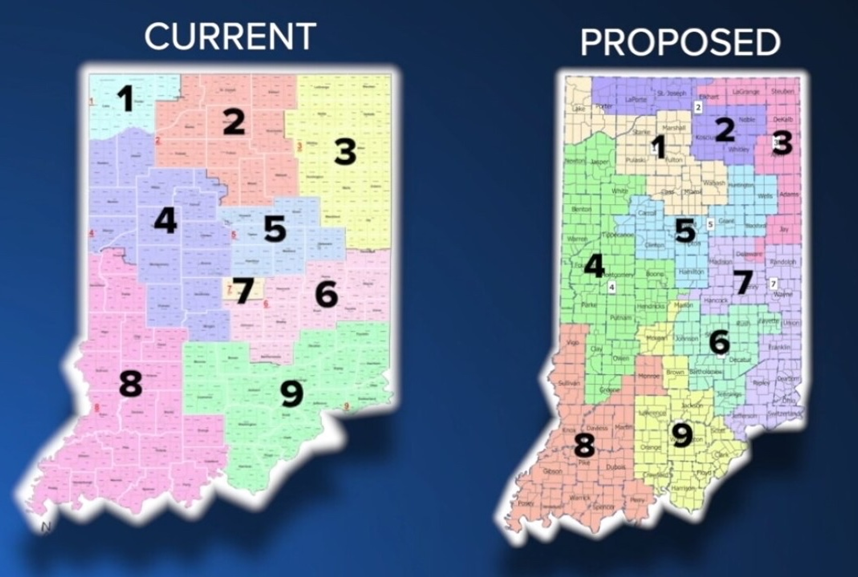
The Indiana House has introduced and passed HB1032 and released proposed congressional maps. Consideration of this legislation now shifts to the Indiana Senate, where public engagement will play a critical role.
Key Facts
1. Legal Context
- Mid-decade redistricting is constitutional but controversial.
- Federal courts continue to review racial gerrymandering claims under the Voting Rights Act and the U.S. Constitution.
- Courts have made clear that minority vote dilution, whether through packing or cracking, is unlawful.
2. Indiana at a Glance
- Indiana has nine congressional districts.
- Proposed maps would divide Marion County into four districts.
- Modeling suggests minority populations would be redistributed in ways that reduce their ability to elect candidates of choice.
- Counties including Marion, Lake, Allen, Johnson, Hamilton, and St. Joseph would be split in ways not clearly justified by population balance.
3. Considerations for Minority Representation
- Section 2 of the Voting Rights Act prohibits minority vote dilution.
- The Fourteenth Amendment limits the use of race as a predominant factor unless necessary to comply with federal law.
- Analysis from nonpartisan groups indicates Black and Latino voters would be dispersed across several districts, weakening collective influence.
- Attempts within HB1032 to restrict judicial review raise additional constitutional concerns.
7th District Impact: Today, Indiana’s 7th Congressional District includes all of Marion County, the state’s most racially diverse county, where the population is approximately 49% white, 33% Black, and 12% Hispanic or Latino. Under HB1032, Marion County would be split across four districts, each reduced to about 11% Black and 4% or less Hispanic population, significantly weakening the ability of minority voters to collectively influence representation.
4. Policy Priorities for Hoosiers
- At a time when families across Indiana are concerned about health care access, food affordability, utility costs, education, and workforce stability, many residents question whether mid-cycle redistricting reflects the most pressing needs of communities statewide.
Why the Senate Matters
The Indiana Senate will determine whether HB1032 advances. Senators have the authority to vote the bill down or prevent it from moving forward. Previous Senate actions demonstrate that lawmakers can choose to prioritize stability and core policy issues over mid-cycle map changes.
Call to Action
Hoosiers are encouraged to remain informed and engaged by doing the following:
- Review the proposed HB1032 redistricting maps
- Share feedback respectfully with Indiana Senate leadership
- Contact Senate offices to express opposition to mid-cycle redistricting and HB1032
- Emphasize the need to focus legislative efforts on issues affecting daily life, including health care, food access, utilities, and cost of living
Indiana Senate contact line:
(317) 232-9400
Public participation helps ensure decision-making remains transparent, accountable, and responsive to community needs.